
 I’ve been learning more about the health and life benefits of gratitude. We are now entering the holiday season so it seems doubly on topic. I was gifted with a mother who learned to find gratitude in all situations later in her life. I’ve often thought back to that time and how I might incorporate more gratitude into my life. While gratitude is a needed quality for our lives at any stage, it becomes something we can more readily access as we approach and live in retirement. As we age, it turns out that our ability to feel grateful goes up. The amygdala, in our limbic system, becomes less reactive to negative information and increases our ability to react to positive information. Being able to focus in on the positive helps us more readily notice what we are grateful for. And that will bring us all sorts of benefits as we age. 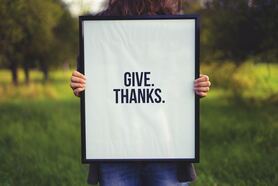 What are the benefits? Here are several of the ways that cultivating gratitude in our lives has been shown in several studies to better our wellbeing:
Pretty impressive, right? Would you like to add more of the benefits of gratitude to your life?  Here are a few easy ways to integrate it into your life:
What a fun and happy way to improve your health, your life and your longevity! What do you have to be grateful for today? Sources:
2 Comments
 I was recently one of the featured speakers at a wonderful women's group. We were covering topics on life after 50. One of the lines in the event marketing asked, “Is 50 the new 30? Is 60 the new 40?” My reply to that is, “Do you really want it to be?” We are aging differently now and, at 60, we are often as active and healthy as people a generation or two ago were at the age of 40. What I mean by asking if we really want 60 to be the new 40 is that, for me, that sounds like we want life at 60 to stay as life was at 40. With this healthier picture of aging, we are afforded and invited to open up to new gifts in our 50s, 60s, 70s and beyond that we wouldn’t have been ready for in our 30s and 40s. We haven't necessarily had these opportunities clearly modeled by previous generations due to their shorter lifespans. The number of years of retirement or later life has increased in the last 50 years. In 1970, someone turning 60 would expect to retire at age 64 and live to age 70.8. In 2010, someone turning 60 could expect to live to at least 78.7 years old. Today, a woman turning 65 can expect to live to 86 and a man to 84. One in three of them will live past the age of 90, one in seven past 95! We could choose to live those extra years with the same approach people used when they had shorter lifespans fifty years ago and simply wind down and wait for the end of life. We could also go the other route and try live those years like we are 40. I'm for both staying active and remembering to embrace the invitation to this part of life to see what it stirs in our lives. Here are some of the gifts this stage of life brings that we can grab on to in our 50s, 60s, 70s, and beyond: Seeing the Forest Our brains work differently by our 50s and 60s. While we often worry about what we are losing when we can't pull up a name, there are also new skills and abilities that open up at this stage of life. The connections between distant parts of our brains actually strengthen. These connections help us become better at seeing the relationship between different pieces of information or seeing the big picture more clearly. We thus are better able to see the broader implications of issues (and not sweat the small stuff so much). Our problem-solving skills are actually improved, as is our vocabulary. How are you making use of your broader point-of-view? How can you help others to see this broader perspective? Purpose and Meaning With our change in pace and sense of time moving on, we get more focused on making good use of our days and reflecting on what we is meaningful for us. With our increased ability to think more broadly, we choose how we use our time differently than we would have a decade or two earlier. We know that purpose and meaning are an important component for healthy aging and longevity. How are you identifying and connecting with what gives you a sense of meaning? More Confidence and Independence People in their 60s report being less concerned about what others think. They feel free to show up as themselves and pursue what they are interested in. How are you seeing yourself show up in a new way? Greater Compassion With broader perspective and experience, we can parlay all we’ve seen and understand to more points of view of a situation. This helps us reach out to more people and their different approach to life. Are you letting yourself mix with and enjoy a wider range of people? While many of us will be lucky enough to be as healthy as the previous generations were when they were 20 years younger, let's not forget to fully live into this part of life and all its new gifts. Our generation has the opportunity to rewrite what our 50s, 60s and beyond looks like rather than mimic earlier times. There's more to life... References:
|
AuthorRuth Tongen helps people plan and live meaningful, fun and healthier retirements. Archives
January 2022
Categories
All

|

 RSS Feed
|
Ruth Tongen 952-223-1121 ruth@ruthtongen.com www.ruthtongen.com Copyright © ruthtongen.com. All Rights Reserved. |
Questions or to
Schedule a Free Consultation Sign up to receive Meanderings:
The New Retirement via email x
Receive a copy of Meanderings: New Ideas for Retirement in your email.
|